
Analyzing Korean political YouTube chats with Kouchou AI (Hankook Ilbo)
For the Hankook Ilbo (한국일보) series "유튜브 부족주의" (YouTube Tribalism), NISHIO Hirokazu (Digital Democracy 2030) used Kouchou AI to analyze live-chat messages from six Korean political YouTube channels collected by the Hankook Ilbo. The results were featured in two articles on October 22, 2026. This page publishes the results of that analysis.
Does YouTube chat look different when grouped without "camps"? A Japanese engineer looking for "citizens' voices" 유튜브 채팅도 '진영' 떼고 묶으면 달리 보인다? '시민 목소리' 찾는 日엔지니어Hankook Ilbo, October 22, 2026
An interview with NISHIO Hirokazu conducted on October 8, 2026. It shows how Kouchou AI visualizes chats from Korean political YouTube, how opposite opinions on the same topic end up in the same group, and the idea of finding citizens' concerns hidden behind the conflict between camps. The article also covers the work of Code for Japan.
Read the article (Korean, new tab) →Is Korean political YouTube failing as a place for public debate? A Japanese engineer's diagnosis 한국 정치 유튜브, 공론장으로 낙제점?… 일본 엔지니어의 진단은Hankook Ilbo, October 22, 2026
An article on the results of analyzing chats from six political YouTube channels with NISHIO Hirokazu and Kouchou AI. Support for and attacks on particular politicians and calls to exclude the other camp were common, and discussion that could lead to policy was rare, but no topic was dominated by only one camp. The article also discusses why the voices on a single platform should not be taken as public opinion as a whole, and why opinions should be gathered through several channels.
Read the article (Korean, new tab) →The data
From the January–August 2026 live chats of three progressive-leaning channels (Kim Eo-jun's News Factory, Maebul Show, Lee Dong-hyung TV) and three conservative-leaning channels (Ko Sung-kook TV, Lawyer Bae Seung-hee, Sinuihansu), 500 messages were selected from each channel, 3,000 in total. "Progressive-leaning" and "conservative-leaning" are general classifications of the channels and do not indicate the views of individual posters.
Opinion maps
Maps made with Kouchou AI. Each dot is one extracted opinion; dots that are closer together are more similar in content. You can switch between 日本語, English and 한국어 at the top of each map.
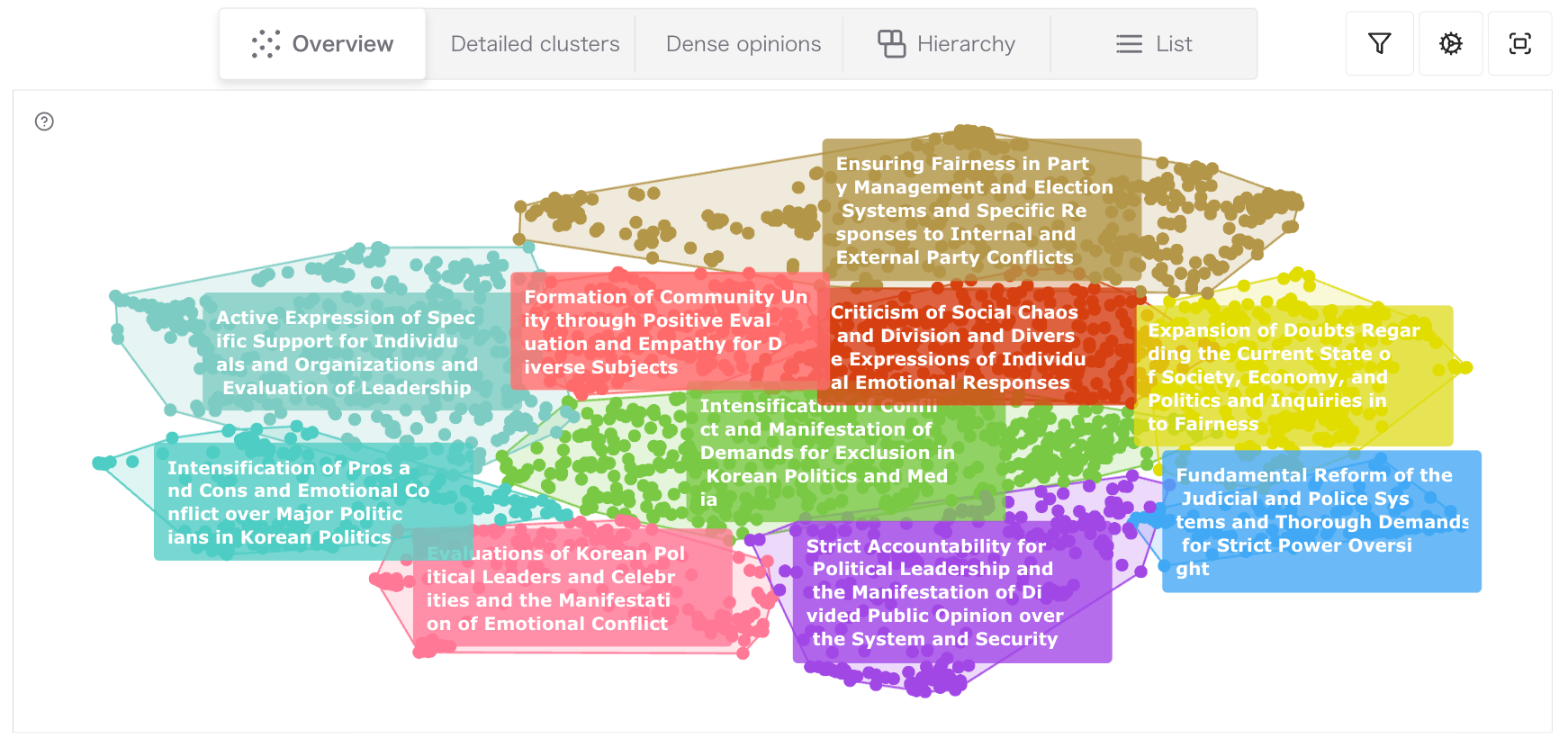
Maps by channel (each is built separately, so positions and groups do not correspond to the other maps):
- Kim Eo-jun's News Factory (progressive-leaning)
- Maebul Show (progressive-leaning)
- Lee Dong-hyung TV (progressive-leaning)
- Ko Sung-kook TV (conservative-leaning)
- Lawyer Bae Seung-hee (conservative-leaning)
- Sinuihansu (conservative-leaning)
What we found
The large topics were shared by both camps
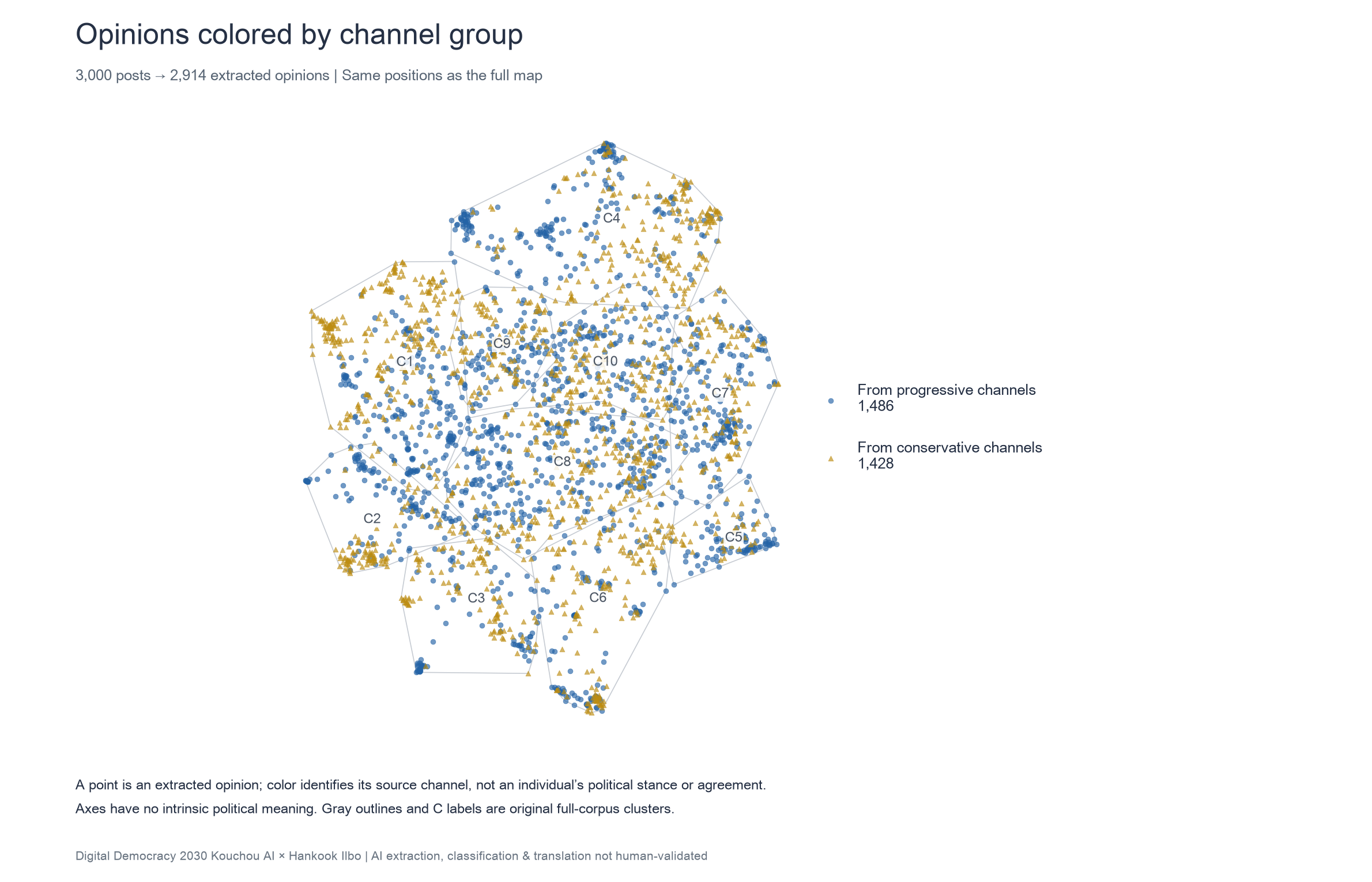
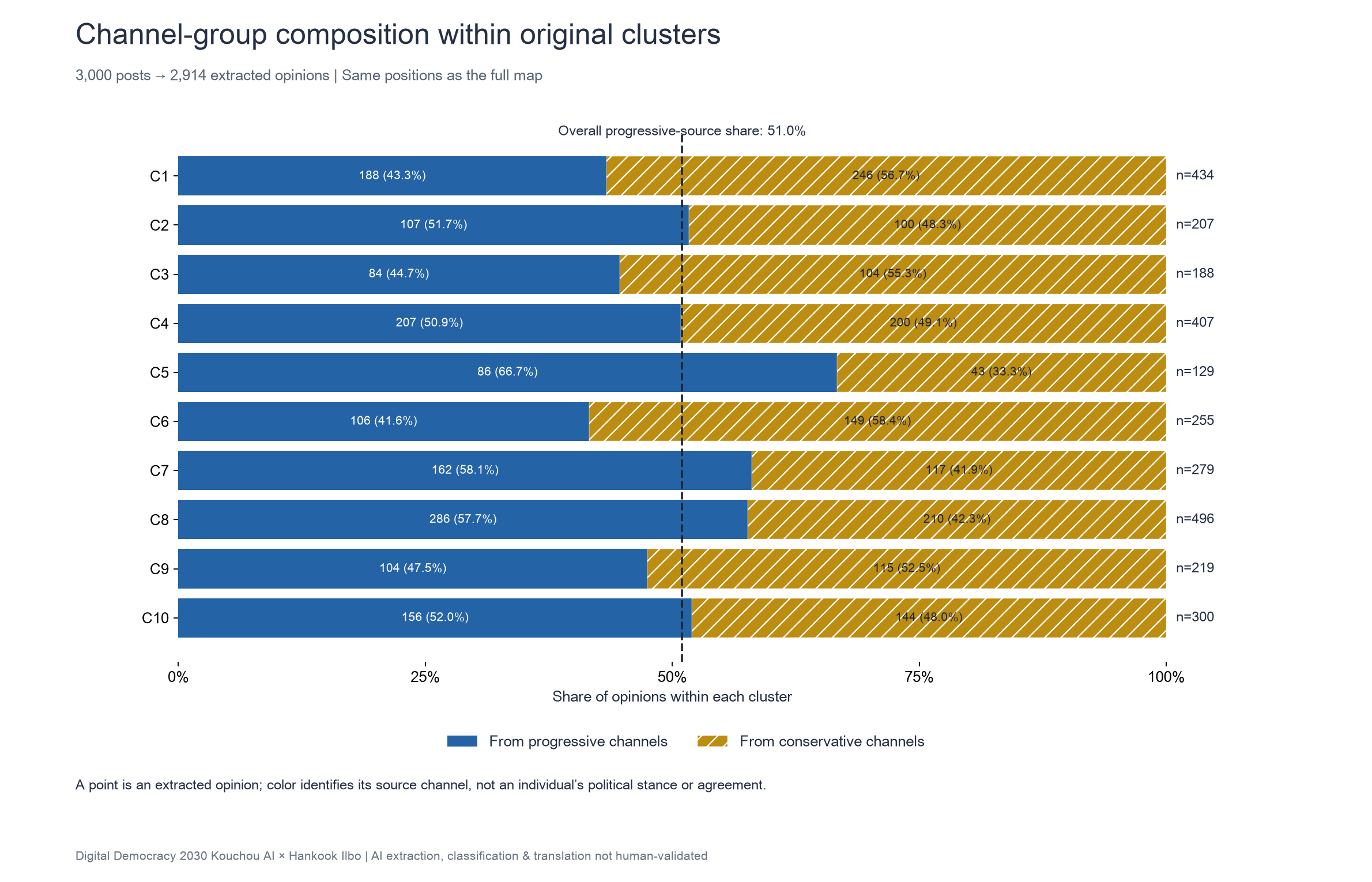
Opinions were extracted from 2,663 of the 3,000 messages, and identical sentences were merged, giving 2,914 opinions. When these were divided into ten groups, the largest was "escalating conflict and calls for exclusion" (496 opinions), followed by "expressions of support for individuals and organizations and evaluations of leadership" (434). In every one of the ten groups, the share of opinions from progressive-leaning channels was between 42% and 67% (51% overall); no group came only from the channels of one camp. What leaned heavily to one side were smaller groups about particular people.
Opposite opinions on the same topic fall into the same group
Kouchou AI groups opinions by what they are about, not by who said them. So opposite opinions on the same topic end up in the same group. Being in the same group does not mean holding the same position. We did not calculate shares of support and opposition.
7.1% of opinions were labeled as insults or hate
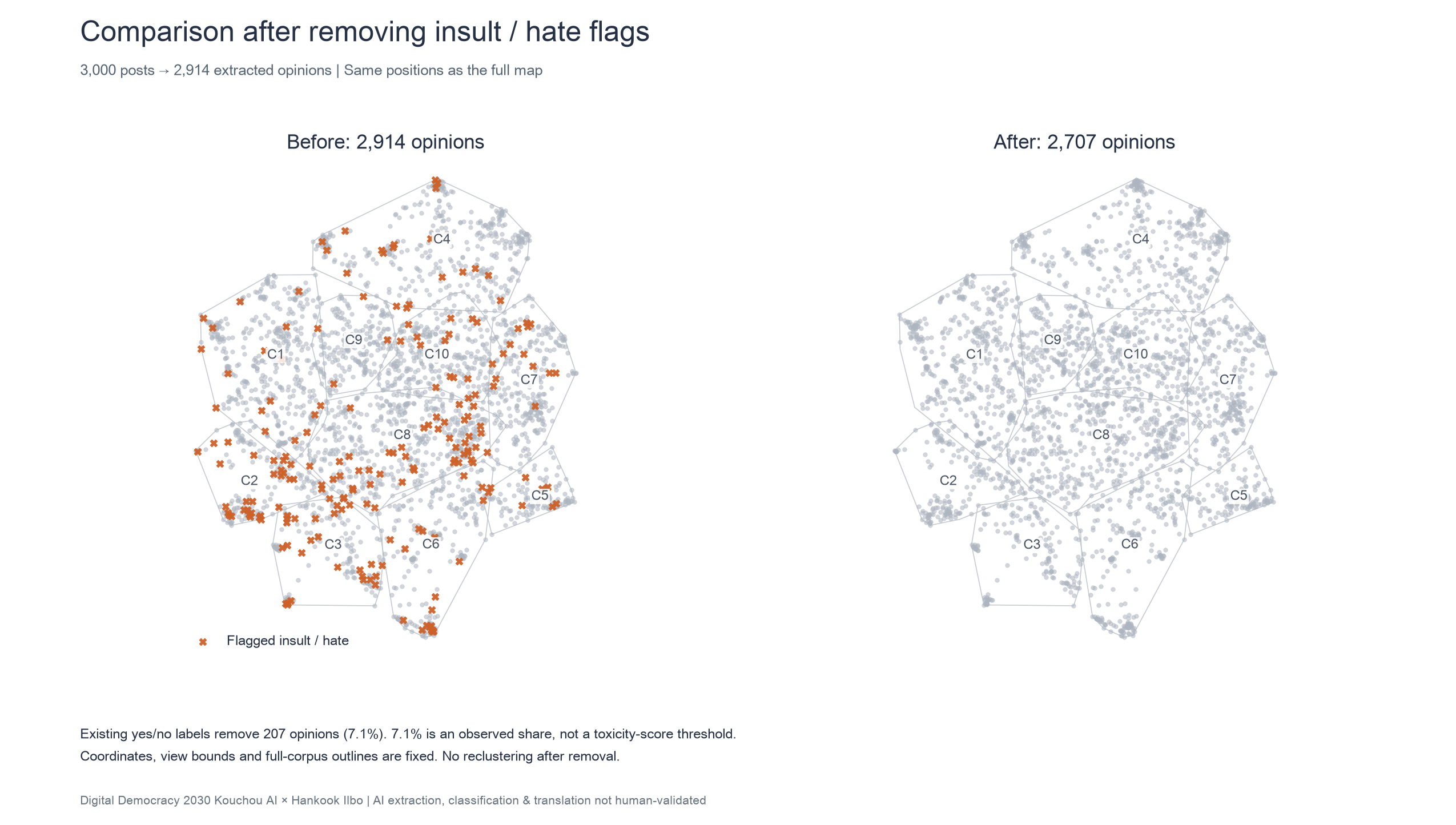
When AI judged each opinion for insults or hate speech, 207 of the 2,914 opinions (7.1%) were labeled as such. Instead of deleting them, we show where they are on the map.
Opinions that could lead to policy are few, but they exist
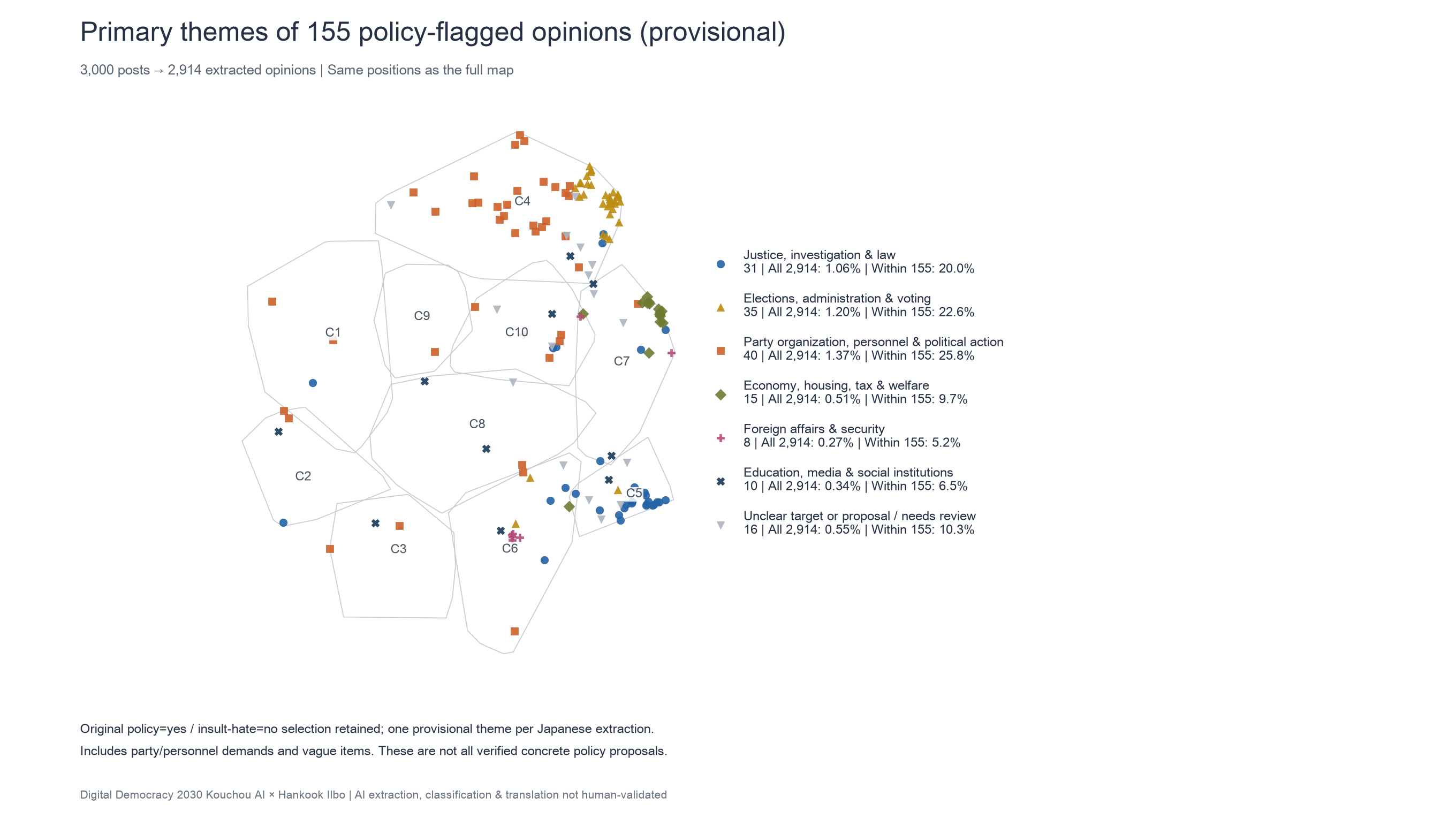
155 opinions (5.3%) were judged by AI to be proposals about policy or institutions and not judged to be insults or hate. They fall into themes such as the judiciary and investigations, the electoral system, party management, and the economy, housing and taxes. The themes were assigned provisionally from the Japanese extracted text and include demands about parties or appointments and vague statements.
Notes for readers
- The 3,000 messages were sampled equally from each channel and are not a representative sample of all chats or of public opinion. The number of dots is not a number of people or a level of support.
- Group names, descriptions, extracted opinions and labels were produced by AI and may contain errors. For example, some group names did not match their contents.
- Opinions were extracted in Japanese; the English and Korean text is machine translation and has not been checked by Korean speakers.
- The axes of the maps have no meaning. Beyond "closer dots are more similar in content," the layout carries no meaning.
- Under the data provider's conditions, the original chat messages and links to them are not included.
Method
Using Kouchou AI, opinions were extracted from each chat message as Japanese sentences with gpt-4.1 and converted to vectors with text-embedding-3-small. They were laid out in two dimensions with UMAP, divided into 100 groups with k-means, and merged into ten groups with Ward's method; group names and descriptions were generated by an LLM. The insult/hate and policy-proposal labels are yes/no AI judgments on the Japanese extracted text and have not been verified by people. Translation into English and Korean was done with a locally run Gemma 4 12B-based model.